How Assigning a Different Sensory Anchor to Each Day of the Week Creates a Subtle but Reliable Rhythm
Robert Kim
09/12/2026
5 min read
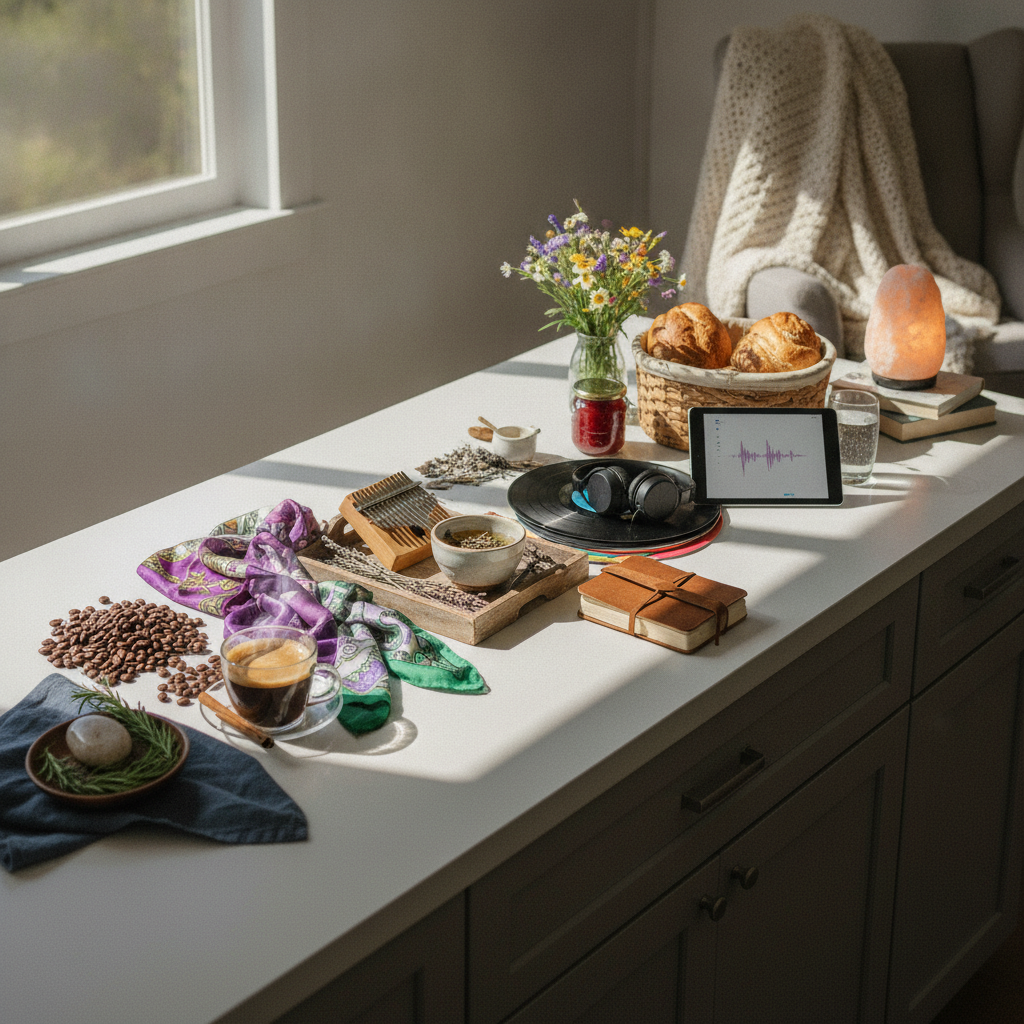
Time, left unmarked, has a tendency to blur. Days accumulate without distinction, weeks pass in a wash of sameness, and the mind — which craves both novelty and pattern — quietly loses its footing. One of the more understated remedies for this drift is the practice of sensory anchoring: assigning a distinct sensory experience to each day of the week, not as a task or obligation, but as a quiet signature that gives each day its own character. It's a practice that asks very little and returns something surprisingly steady.
The Logic of Sensory Memory
Human beings are far more attuned to sensory information than daily routines typically acknowledge. Scent, texture, sound, and light each carry enormous associative power — the smell of a particular tea, the weight of a specific blanket, the sound of a record played on a specific afternoon. These aren't merely pleasant details; they function as memory anchors, markers that the brain uses to distinguish one stretch of time from another. When a sensory cue is repeated consistently on the same day, it begins to signal something deeper than habit — it becomes a temporal landmark. The brain starts to associate that cue with a particular emotional register, a particular pace, a particular kind of attention. Over time, those associations build a texture into the week that no planner or productivity system quite replicates.
Building the Anchor Set
The practice works best when kept genuinely simple. Monday might be anchored by a specific scent — a candle from Diptyque, or a particular blend of loose-leaf tea brewed only on that morning. Tuesday might carry a tactile anchor: linen pillowcases swapped back onto the bed, or a specific textured mug reserved for that day's coffee. Wednesday could be sound — a particular playlist, a podcast listened to only mid-week, or even the deliberate ritual of opening a window to let ambient street noise fill the room for twenty minutes. Thursday might belong to light, with a lamp angled differently or a meal eaten near a window as the afternoon softens. The anchors don't need to be elaborate or expensive; they need only to be consistent and genuinely sensory — meaning they register in the body, not just the mind.
Why the System Works Without Effort
What distinguishes sensory anchoring from conventional habit-stacking is its passivity. Most productivity frameworks ask the practitioner to remember, initiate, and sustain. Sensory anchors, by contrast, do their work almost involuntarily once established. The moment a specific scent enters the room, the nervous system orients — not dramatically, but perceptibly. There's a subtle recognition: this is what this day feels like. Researchers in the field of embodied cognition, who study the relationship between physical experience and mental processing, have long noted that the body often carries knowledge the conscious mind hasn't formally registered. Sensory anchors exploit that channel. They don't require discipline so much as repetition, and repetition, in this context, is easy because the anchor itself is pleasurable rather than demanding.
Cultural Roots of Sensory Ritual
This idea is far from new, even if its current application feels modern. Many cultures have long used sensory ritual — shabbat in Jewish tradition marks the weekly transition through specific smells, candlelight, and food textures that signal a categorical shift in time. The Japanese concept of ma (間), meaning the pregnant pause or meaningful interval between events, speaks to the same underlying principle: that time gains quality not from what fills it, but from how transitions are felt. In Scandinavian domestic culture, the practice of hygge — the cultivation of coziness through specific atmospheric conditions — is essentially a sensory anchoring system applied to seasonal time. These traditions persist not because they are efficient, but because they are deeply satisfying to the nervous system in ways that pure scheduling cannot match.
Adapting the Practice to Real Life
For those whose weeks follow irregular patterns — freelancers, parents of young children, shift workers — the anchors simply shift with the actual rhythm rather than the calendar name. The anchor belongs to the felt first day of the working week, the midpoint, the wind-down. Apps like Finch or Notion can carry a simple one-line note tracking which anchor belongs to which day, removing the need to remember. Neighborhoods with distinct sensory offerings — a bakery that only operates Tuesday through Saturday, a farmers' market that sets up on Thursdays — can provide ready-made anchors without any additional purchase. The goal is texture, not perfection. A week in which four out of seven days carry a reliable sensory signature is already a week that feels more inhabited than one that doesn't.
Letting the Rhythm Do Its Work
Once the anchors are established, the practice requires almost nothing. The rhythm begins to hold itself, the way a well-tuned instrument eventually holds its pitch without constant adjustment. You may notice that your mood on a Wednesday afternoon arrives with a faint readiness before the playlist even starts, that the particular scent associated with Sunday morning carries a kind of permission to slow down that no to-do list can quite manufacture. The anchors begin to make the week legible in a new way — not through what was accomplished, but through what was felt. In a culture that persistently measures time by output, there's something quietly radical about a system that measures it by sensation instead.
Time, left unmarked, blurs. But time given texture — even the lightest, most sensory kind — accumulates into something that can be recognized, returned to, and genuinely lived in. The week becomes less a container to fill and more a sequence of experiences to inhabit, each with its own quiet signature, each distinct enough to remember.



